

Promoted by the European Union, micro-credentials enable short-term learning achievements to be certified digitally in a way that is interoperable and easily shareable between institutions, businesses and professionals across Europe.
Why are micro-credentials so important?
Microcredentials address an increasingly pressing need: the ongoing updating of skills in an ever-changing labour market.
Unlike traditional qualifications, they enable individuals to demonstrate specific skills acquired through courses, specialist training, practical experience or specific training pathways. This is particularly relevant in sectors where technological innovation is advancing rapidly and training needs are constantly changing.
Its main advantages include:
- Greater flexibility for students and professionals.
- Training that is better tailored to real, specific skills.
- Digitally verifiable identification throughout Europe.
- Improving employability and career mobility.
- Seamless integration with digital learning and workplace ecosystems.
Furthermore, micro-credentials support lifelong learning, one of the European Union’s key strategic objectives in the field of education.
European tools for designing, creating and signing micro-credentials
The European Union has developed various tools and technical frameworks to facilitate the creation of interoperable digital credentials.
Among the most significant are:
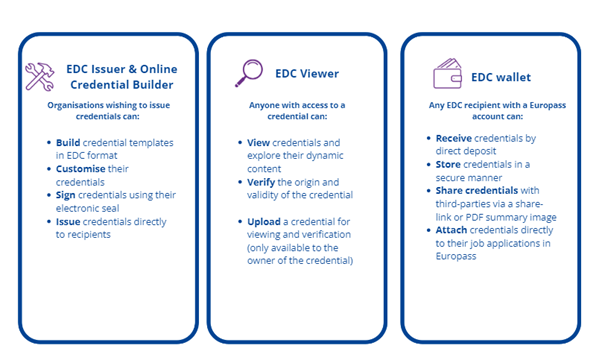
- The model of European Digital Credentials for Learning (EDC), which defines the European standard for digital credentials.
- The infrastructure Europass, which allows you to store and share verifiable credentials.
- The tools EDCI (European Digital Credentials Infrastructure), oriented to issue, manage and check digital credentials.
- Electronic signature and validation systems that guarantee the authenticity, integrity and traceability of the credentials issued.
Thanks to these tools, educational institutions and training organisations can issue structured, verifiable digital certificates that are compatible with European standards.
Micro-credentials and digital wallets such as Europass
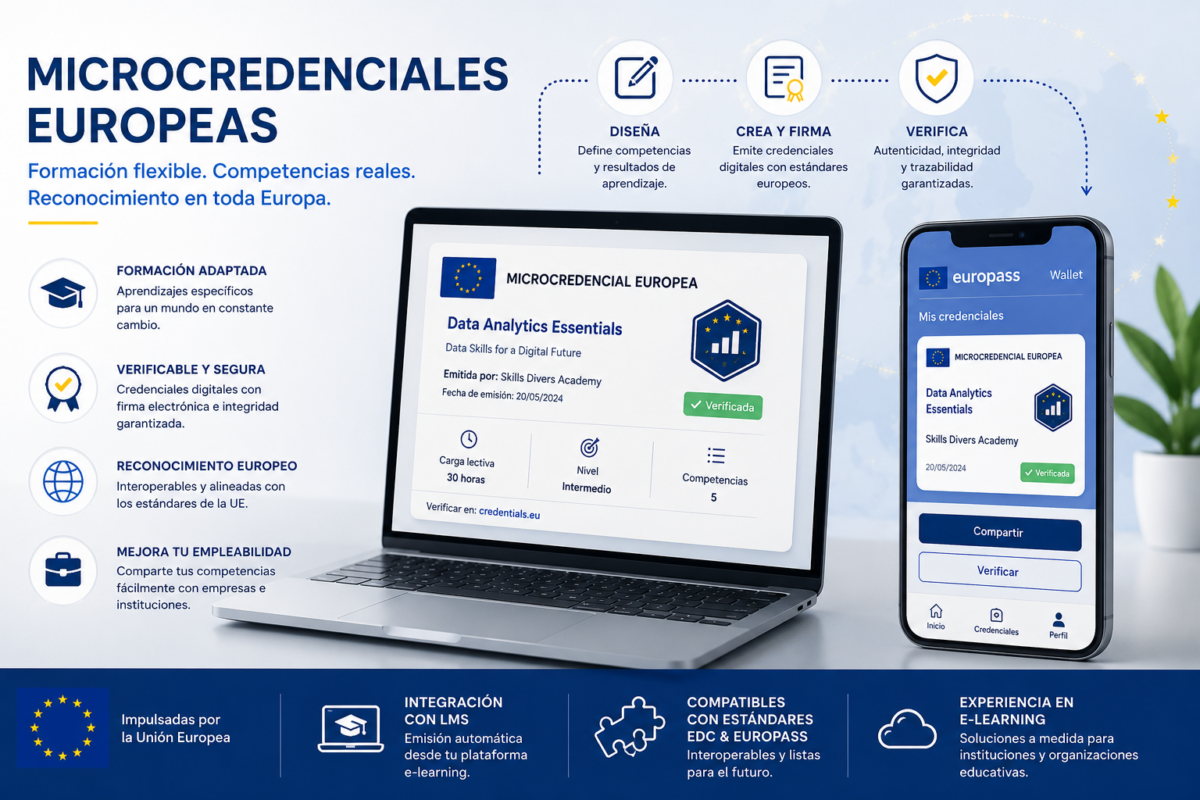
One of the most innovative aspects of European micro-credentials is their integration with digital wallets such as Europass. These wallets allow students and professionals to store their digital credentials securely, enabling them to share them easily with companies, educational institutions or public bodies. This represents a major advantage over traditional PDF or paper certificates, as digital credentials:
- They can be verified automatically.
- They reduce document fraud.
- They facilitate international mobility.
- They enable skills and achievements to be incorporated into digital professional profiles.
Furthermore, the European ecosystem is moving towards models that are increasingly linked to European digital identities and interoperable authentication systems.
Our expertise in e-learning and LMS integration
At Skills Divers we have extensive experience in developing e-learning solutions, training platforms and European projects relating to the digitalisation of education, vocational training and digital credentials.
We are currently working on integrating European micro-credentials with various Learning Management Systems (LMS), enabling the automated issuance of digital credentials upon completion of courses and training programmes.
Our experience includes:
- Integration of digital credentials into Moodle platforms.
- Automated generation of credentials in JSON-LD format.
- Alignment with European standards EDC and Europass.
- Automation of validation and issuance processes.
- Designing scalable solutions for educational projects and training organisations.
The combination of online learning, European interoperability and verifiable credentials presents a major opportunity to modernise educational ecosystems and improve the recognition of skills across Europe.
Microcredentials are no longer just a future trend: they are beginning to become a key element of European digital education and training.
We encourage you to find out more about our plugin to create micro-credentials in accordance with European standards in Moodle at this link.
If you’d like to find out more about what we do, please visit our Projects.
 English
  Spanish